A dream of restoration on Camlough Mountain

A dream of restoration on Camlough Mountain
Thinking about an ideal ecological restoration plan on Camlough Mountain, Co. Armagh
Often when I am exploring my regular haunts, I have idealistic thoughts about ecological restoration plans being put in place. One of those places in the northern side of Camlough Mountain just west of Newry. In recent months I have been finding some really interesting species from the site. There is a humid microclimate at this site and there are temperate rainforest elements without a doubt. Amazingly, I have recorded Irish Daltonia (Daltonia splachnoides), which I have discussed before on here. It grows on the willow set within a terrible Sitka plantation. D. splachnoides is critically endangered and it is just growing here, unassuming. The tiny hyper-oceanic liverwort Colura calyptrifolia grows in insane abundance here too. Remaining in the hyper-oceanic theme, I came across a single plant of Dryopteris aemula, a fern endemic to northwest Europe, deeper within the plantation. Other important plants include the endemic Irish Whitebeam (Sorbus hibernica) and various other species like the beautiful acrocarpous moss Breutelia chrysocoma.
I would love to see a restoration plan in place. Where the canopy of Sitka gives way and allows light to filter through, the mossy and ferny forest floor shines so brightly. The foundation of a lovely humid upland woodland with rowan, downy birch and hawthorn is right there. Alas, the plantation is nearing harvest time and I dread to see the aftermath. I am a bit naive in thinking that by asking the Forest Service to relinquish some land for biodiversity would be an easy task. The entire mountain, except for the higher summit, are plastered in plantation. Surely, they could spare some space for biodiversity and ecological restoration. I can see visions of a lovely woodland forming, where rare ferns, mosses and liverworts can thrive and spread, bringing with them the invertebrates and birds which deserve the space too.
I live in hope; who knows really. I believe that we deserve it. It is worth trying and is not an expensive endeavour – I wouldn’t be advocating for tree planting and deer fencing if I was the manager of the restoration plan. There is little grazing pressure here and natural regeneration is always preferable. Still, supplementary planting of oaks and hazel might be beneficial, but there are small oaks popping up around the area, presumably from jays. Sometimes, we are in such a rush to see a habitat ‘completed’ that we forget that there is no such thing.
The challenge is, the species that I have mentioned are not formally protected, therefore, there are no environmental legislation that would incentivise or demand a sensitive land management practise to be in place. This forms part of a larger issue within ecology, when we look at what species are actually protected and why others which are clearly in equally, if not worse, conservation status, are overlooked. Badgers, bats, bluebells – these are protected but are in no way rare. The charismatic species get first pick of the conservation efforts and no one thinks about Daltonia splachnoides, except for some sad bryologists…
In the end, these species are still there right now, but for how much longer I don’t know. Community-based activism is a powerful tool, but unfortunately, most people are unaware what a real woodland is supposed to be, never mind caring about a fern. Maybe that is something I can work on. Stay tuned I guess…
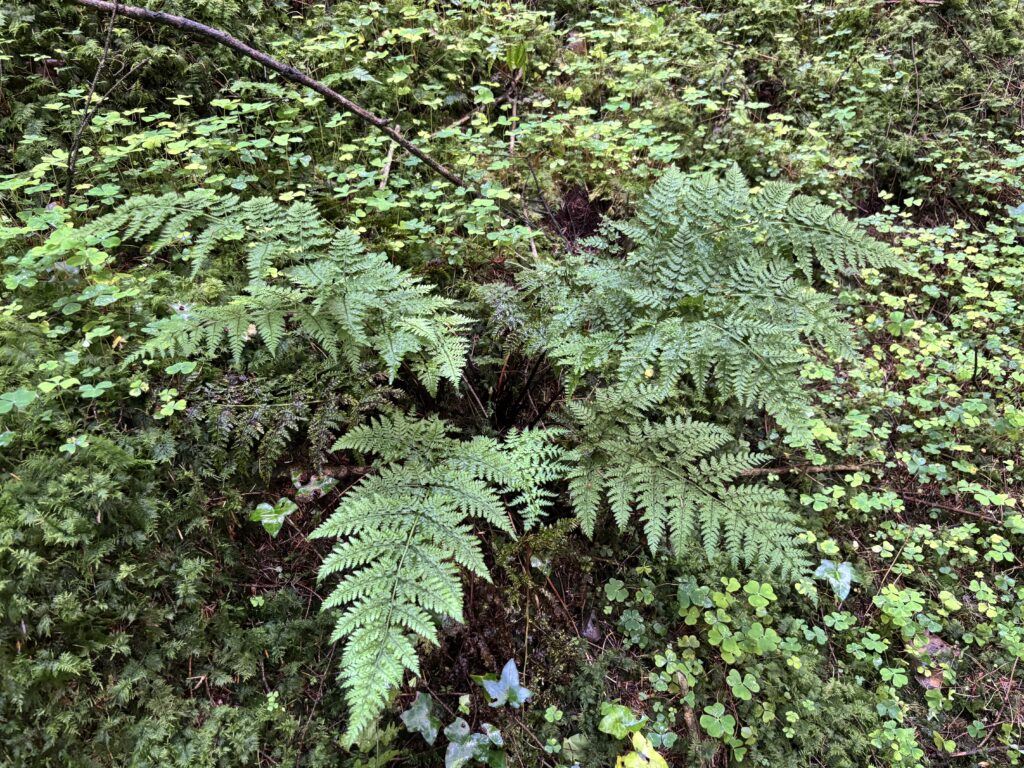
Dryopteris aemula – the hay-scented buckler fern from Camlough Mountain, found only in the Atlantic zone of northwest Europe!